Showing posts with label research. Show all posts

Friday, 24 January 2014

What is Important to Think About When Creating a Film Poster?

- Choosing the right image.
- Inspiring mystery and not giving away the plot.
- Getting people’s attention, making them want to see the film.
- Informing people of which actors/actresses are in the film
- Informing people of who the producer(s) and director(s) are.
- Using the space well and not overcrowding the poster with text.
- Using colour well, not too much or too little.
- Making sure good fonts are used.
- Make sure ALL important information is on there, like release dates.
- Contrast between the text and picture.

This video is one of the things I watched in order to gather research on how to make a effective movie poster...


-RM (spelling and grammar edited by BW)

POSTER - Which Images Will I Use? Why Are They Important?

The photograph is the most important thing about the film poster, in my opinion. This is the image you are using to advertise your film to the public, therefore it needs to try and represent the film in one image. You wouldn't want to use a photograph of something that gives away too much, otherwise people won't feel the need to come and see it. I am currently in the processes of choosing the image I want to use in the film poster, as I want to make sure I get it right. I am stuck between two image that are totally differer and have two different feels to them.

The first image I am thinking about using is one of all the boys whom play Alex throughout the film at different ages. The thing I like about this is you can see the connection of these boys which is essential for the viewer, however the picture looks more like a family photo and it may give off the wrong impression of our film. The second image was of the time traveller with his head down so you cant see his face at all and is dressed in head to toe in dark colours. This image shows this figure as mysterious and works well creating tension.

Below are some example of good film posters:


I think all these posters are good as they get across all the information film posters should and used an image effectively. One of the most important things is the layout of the poster. This is essential in order for the poster to not look crowded and messy.

The image I use for our film poster needs to be as effective as all these to achieve what I want from this part of the advertising.


-RM (spelling and grammar mildly edited by BW)


Wednesday, 22 January 2014

Different Styles of Reviews

  • BFI Sight & Sound:


The acronym is, appropriately, WOWS. The Wolf of Wall Street is a film of yuppie pastels in the bright light of the world’s vacation spots, so crisp as to seem slightly unreal. It’s three hours of wall-to-wall bunga-bunga partying, with orgiastic excess that evokes Jay-Z’s ‘Big Pimpin’’ music video,Bob GuccioneJohn Casablancasvon Stroheim and Cecil B. DeMille.
USA 2013
Certificate 18 179m 55s
Crew
Director Martin Scorsese
Produced by Martin Scorsese, Leonardo DiCaprio, Riza Aziz, Joey McFarland, Emma Koskoff
Screenplay Terence Winter
Based on the book by Jordan Belfort
Director of Photography Rodrigo Prieto
Edited by Thelma Schoonmaker
Production Designer Bob Shaw
Sound Mixer James Sabat
Costume Designer Sandy Powell
Cast
Jordan Belfort Leonardo DiCaprio
Donnie Azoff Jonah Hill
Naomi Lapaglia Margot Robbie
Mark Hanna Matthew McConaughey
Manny Riskin Jon Favreau
Patrick Denham Kyle Chandler
Max Belfort Rob Reiner
Jean-Jacques Saurel Jean Dujardin
Dolby Digital/Datasat/SDDS
In Colour
[2.35:1]
Distributor Universal Pictures International UK & Eire
thewolfofwallstreetuk.tumblr.com
UK release date 17 January 2014
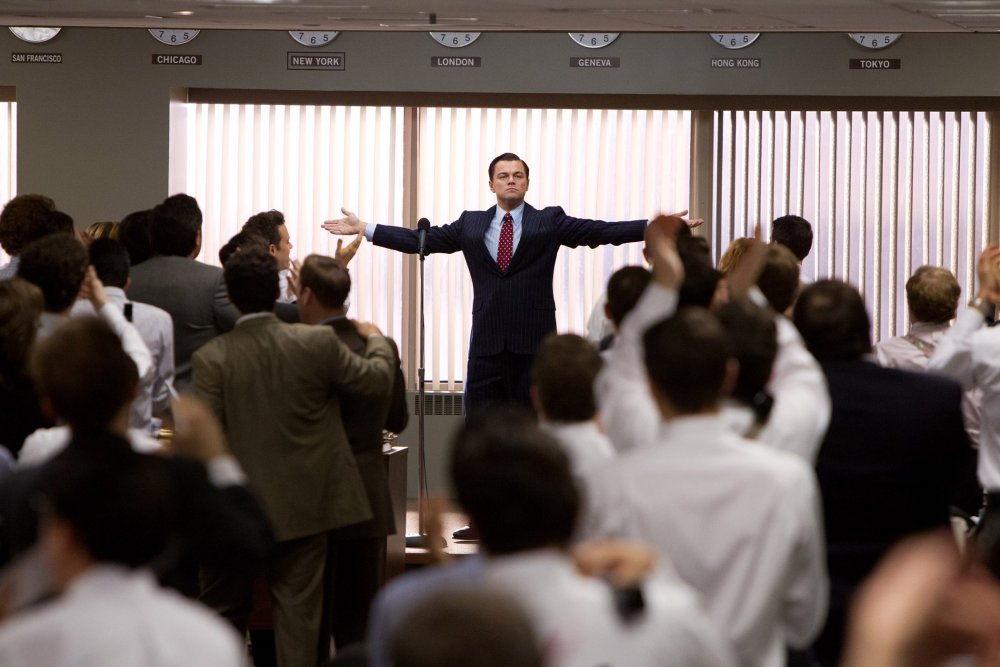
Stockbroker Jordan Belfort, the ‘wolf’ of the title (played by Leonardo DiCaprio), thrives as master of ceremonies in a milieu where the only self that matters is the performed self. Like a great number of Scorsese protagonists with whom he otherwise wouldn’t seem to have much in common, includingTravis Bickle and Rupert Pupkin, Jordan only exists when validated in the eyes of the world. The offices of Stratton Oakmont aren’t just a workplace for Jordan, but his own private public theatre, a place where he can stalk the boards, reassuring himself of his own success by re-enacting the legend of it.
When preparing to step down in return for clemency from the Securities and Exchange Commission, Jordan reneges in front of his office – he realises that if he ceases to be Stratton Oakmont, he ceases to be. When Jordan’s lieutenant Donnie Azoff (Jonah Hill, wearing bleached teeth and playing a version of Jordan’s real-life accomplice Danny Porush) needs to prove a point, he makes a soapbox of the nearest handy desk and acts out his power play in full view of the ‘wolf pit’, eating one hapless employee’s goldfish, or pissing on a subpoena. With the offices the scene of many a group grope, even sex isn’t private.


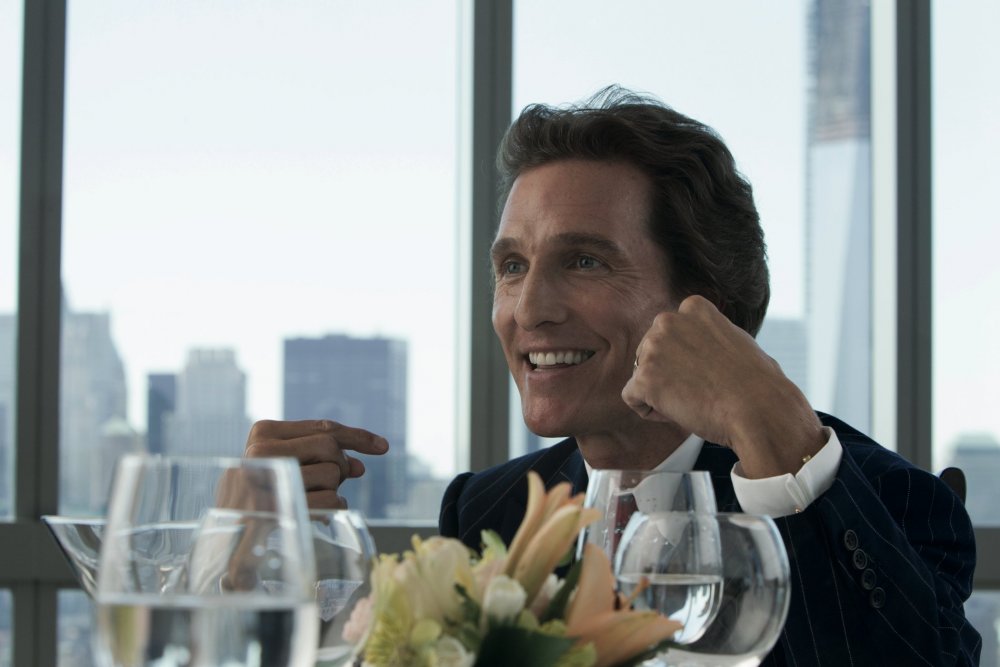
Jordan is a born bullshitter and, like many bullshitters, he has the gift of inspiring supreme confidence. In the business of selling speculation, talk is the coin of the realm, and The Wolf of Wall Street is enamoured of palaver, from the Texas smooth talk of Matthew McConaughey, playing Jordan’s mentor Mark Hanna, to the blue-collar New York Jewish patter of Rob Reiner as Jordan’s towering, hotheaded father. Loaded with thrilling verbal runs, this film is the nearest thing to a pure comedy that Scorsese has made since 2006’s The Departed.
Based on Belfort’s own memoir and written for the screen by Terence Winter, Wolf lacks The Departed’s suspense-making genre architecture. The film is essentially a chain of anecdotes: Jordan interrogating his gay butler for money that went missing during a sex party; Jordan using the family of friends to transfer money into Swiss bank accounts; Jordan’s yacht capsizing when crossing the Mediterranean in a mad rush to retrieve the money from those same accounts. Along with its three-hour runtime, this baggy plotting may make Wolf a somewhat harder sell to audiences but it’s a deeper movie than The Departed – among the best that Scorsese has made.
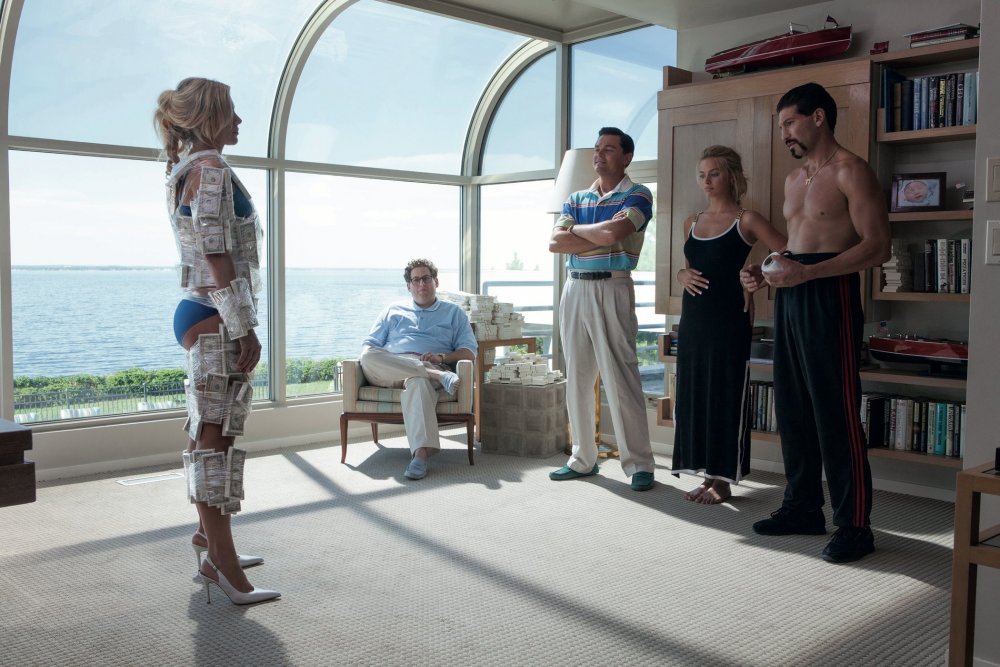
The comedy here isn’t only verbal but also physical, and it’s in this department that DiCaprio’s performance enters the realm of the undeniable. There’s his rubber-torsoed dancing at his wedding party, much giffed since appearing in the film’s trailer, and the elaborate seduce-and-stick-it-in pantomime he enacts while illustrating how to high-pressure sell a cold call via speakerphone. As McConaughey’s character makes explicit in an initiation that hangs over the entire film, sexual release is only a means to prime the pump so as to make more money – the Stratton Oakmont gang even equate different classes of prostitutes with different grades of stocks.


One elaborate physical comedy set piece is the movie’s hysterical high point. It involves Jordan and Donnie incapacitated by elephant-tranquiliser-grade ‘Lemmon 714’ Quaaludes in a moment of crisis that demands fast action and quick thinking. The sight of Jordan desperately trying to get back home, wriggling on his belly towards his Lamborghini Countach and opening the passenger-side scissor door with his foot, made this critic laugh harder than anything else in films in the past year.
When drugged Jordan intercepts drugged Donnie during an ill-advised incriminating phone call, both men wind up flailing at one another on the ground, speech slurred, tangled in the telephone cord, looking like nothing so much as two newborns in a playpen – which, of course, they are, except that the playpen is seven acres on the Gold Coast of Long Island, Jay Gatsby country, the most expensive real estate in the world.
Jordan has a nobler conception of himself. Introducing the shoe designer Steve Madden, whose company Stratton Oakmont is about to take public, Jordan identifies Madden as an artist, the artist’s gift being that he “creates trends”. By Jordan’s own definition, then, his market manipulation is a variety of artistry – and the scenes where Jordan rallies his bullpen to do his bidding are unexpectedly touching in their evocation of the esprit de corps among business-world brigands. Like The Wolf of Wall Street, they are at once energising and enervating, the very centre of a movie that fairly reeks with the sweet stench of success


  • Heat Magazine


This year's BAFTA Film award nominations, and Gravity's up for 12! Not bad, eh?
Posted by Anna Lewis on 08 January 2014 11:460 Comments


Happy BAFTA Film Award Nominations Day to one and all!That's right - today is the day we find out who's up for what in the annual BAFTA Film awards, and it sure is looking good for the cast and crew of space drama Gravity.
The film, starring Sandra Bullock and George Clooney, is up for 12 whole awards, including Best Film, Outstanding British Film, Best Actress for Sandy, and Alfonso Cuaron is up for Best Director.
Talking about the film, Sandra told Magic FM how working with George made the filming process so much more enjoyable. She said: "We've known each other for over 20 years, and there's no one I'd rather do it with because we both know the joke; we both know what it is; we both don't get offended by it. He's a good man - so great in this industry because he loves it so much

  • YouTube reviews:


I really like reviewing a film by filming it as an interview. I think it's effective and people are more likely to watch them than go and buy a film magazine. Also when it comes to YouTube people search a keyword and that video will show up so it's more likely to get watched. They can also be reviewed by amateurs or by professionals.


-CM


What is Your Magazine Review Attempting To Do?

When I write the review I want to attempt to engage the readers:

  • By a quoting the film like in Dirty Dancing a lot of reviewers used the famous quote "No one puts Baby in the corner!"
  • By finding the title and then in italics underneath summarising the film in a few words:
The House I Live In
Eugene Jarecki's devastating doc
  • Comment on the Acting/Voice skills,
  • Comment on the Director,
  • Comment on the Producers/Production Companies,
  • Include Memorable quotes,
  • Include the Release Date
  • Rate it out of 5 stars
  • A short Synopsis that doesn't give away too much of the movie
Outline of a Magazine Review:

  • Title: Includes the movie title
  • Subtitle: optional, but a great way of using the clever slogan like a movie quotation or a play on words
  • Opening Hook: Tease the Reader with a quote, or a question
  • Body: Synopsis, Facts, Opinion (in my case as I'm reviewing my own movie I think it's best to try and write it in the most unbiased way possible but this can be quite hard to do)
  • Conclusion: recommend it or warn against it

Yahoo.com say that these are the top 4 tips on how to write a successful Movie Review:

~Tips on Writing a Successful Movie Review 1. Make it apparent what movie you are reviewing right from the beginning. You don't have to necessarily include this in the opening paragraph, but you need to include it in the title. Online writing makes this step easy, and besides, you want to include the movie title in the article title if you ever want anyone to read your movie review anyway.
2. Try not to immediately say what you thought of the movie if you want the reader to keep reading the whole movie review since your opinion on the movie is the entire reason that the reader is looking for a movie review in the first place.
3. Actually watch the movie first. I know, I know. That sounds like common sense, but it wouldn't surprise me that people would try to write about movies they haven't seen. IMDB might be a great resource for fact-checking, but you actually have to see the movie to develop an actual opinion of the movie, which you need to write a successful movie review.
4. This tip goes back to the mistake I made in writing the movie review: don't use phrase like 'in my opinion'. It doesn't ruin it, but it is totally unnecessary and repetitive to say 'in my opinion' or 'I think'. The reader already knows that you think such-and-such or that it is in your opinion. That's the point of a movie review!~

I think one of the important things to remember when writing the review is to be completely unbiased and to look at a lot of different reviews to see how they've written them.

-CM

What Style am I Using?

I am using a colloquial style like those used in the Empire magazine. I think that this style is fairly easy to read and quite enjoyable as well. Although I do think that what I'll have to go careful with is the way I write I can't make the wording to slang-like but I don't want to make it formal either.
One of the ideas that me and Rachel had was to have a double page spread and to include lot of pictures of the filming of and of the movie poster also we were thinking of having a small interview with us all answering a small amount of questions those t the moment are unknown but I have had a few ideas and have taken them from the Empire Magazine such as the Article below:

This article is from Empire magazine and is a short bio of young actor Tom Holland what I like about this is that clearly it was an interview but they had written it in a biographical giving us short information about his father his previous acting roles and gives us an insight to his world in a short couple of paragraphs.


-CM

Comparison of Two Different Magazine Reviews


Empire Magazine
What I love about Empire magazine is that it's extremely engaging. the first thing that catches your eye when you look at this article is the amazing background picture of the astronomical wallpaper. This then indicates to you that it's otherworldly and it's interesting. plus the quotation: "They don't understand human emotions..." is unusual and makes you want to read on to what they're talking about.
One of the nice things about Empire magazine is that in different ways they promote the film in this article they're talking about Actress Saoirse Ronan and her latest debut: The Host. The Journalist has given a small insight into what The Host is about, that it was originally a fiction Novel by well known author Stephanie Meyer and it gives us a short understanding of what the movie is about without actually giving to much away.
The Journalist has also given examples of other Movies that Ronan has been in and compared the roles so it makes you admire the actress more for her varied roles and realise that at such a young age she is extremely talented.
The format is fairly informal and quite colloquial creating an easy reading review and creates an enjoyable atmosphere. It's great propaganda for the film as they have quotes from the director and the readers can relate to the director and actress as all quotes seem very down-to-earth and human "...the hairs on the back of my neck stood up." (Nick Wechler-Producer) and "Best on-set birthday ever!" (Saoirse Ronan-Actress)
From reading this material I have had a certain understanding of how I would like to write my review I want the review to be eye-catching and colloquial unlike other reviewers such as:

The New York Times

A foul tale foully told, the Israeli horror flick “Big Bad Wolves” begins on a dreamy, once-upon-a-time note with three children playing hide-and-seek. As a boy counts down, two girls, one dressed in red and the other in blue, enter a derelict building. One stays, the other leaves; one dies; the other, well, who knows, much less cares, what happens to her? Certainly not the writers and directors, Aharon Keshales and Navot Papushado, for whom murdered children are just an easy, conveniently blunt and effectively faceless (and headless) means to a self-satisfied, jokey and blood-slicked end.                    


In other words, there’s a serial killer loose, and he’s raping, torturing and decapitating girls, whose heads he then hides, mainly, it seems, to give this otherwise generic setup extra ick. As the police futilely chase clues, a motley triangle emerges: a suspended cop, Micki (Lior Ashkenazi); a religious teacher, Dror (Rotem Keinan); and a mourning father, Gidi (Tzahi Grad). In time, the three converge in an isolated cabin that turns into a chamber of horrors as they play a psychological game of no exit amid Jewish mother jokes, some noshing and one character’s — after taking a blowtorch to another man’s chest — sniffing the air and wistfully reminiscing about barbecue.
In one of those ill-advised director statements included with the press material, Mr. Keshales and Mr. Papushado invoke the “existential anxiety” that “serves as Israel’s foundation” and promise that their movie will ask, “Does being the victim give you the legitimate right” to become a vigilante? Nice try, guys. Although they toss in a sympathetic Arab character, his pacific presence is soon eclipsed by a tortured man’s agony. Is that the point? Is there a point? All the filmmakers seem interested in is the ugliness of the main Israeli characters, each of whom proves a virtuoso of violence. Micki’s weapon of choice is a bluntly wielded phone book, while Gidi prefers a saw and pliers. For their part, the filmmakers do their dirty work with swoopy cameras, shock cuts, giggles and gore.

Although the review is bad it gives away too much of what is actually happening. The Journalist has used a lot of  unusual language such as "derelict" rather than reviewing the film and saying whether the film is good or not the reviewer has just put into words what the movies about it pretty much ruins the movie and doesn't make the movie sound interesting at all. I also think that the Journalist was trying to be clever in his Format and it ended up with a terrible review. Even if the Film was or was not awful it starts to make you think about whether the reviewer is being a fair critic or whether he is thinking of whether he enjoyed it at all.

He is also fairly passive about the good things that happens in the movie, or the actors, the director and the shots it seems to be more of a critique on the plot rather than the way it was made or whether the shots were good or if they used any CGI etc.

-CM

Do Audiences Take Notice of Reviews?

I think the audience look at the reviews before watching the film. Now, considering the technology nowadays people have reviews at their fingertips with applications such as Rotten Tomatoes or Flixter. These show the trailer and often show reviews these allow the audience to decide whether to watch the movie or not.

http://www.rottentomatoes.com/m/the_hunger_games_catching_fire/


-CM

Popular Reviewers

I think some of the most popular reviewers are:
Empire Magazine


The New York Times


IMDB

Heat


The following often write reviews on films. Also a lot of people on the internet write reviews via blogs and YouTube videos. Also TV reviews. 5* often have the top 10 films of the month and in 10 minutes they'll review the film for you.


Also the news often  mention big films when it comes up to awards nights like the Golden Globes and the Oscars. 


-CM

Does a Bad Review Ruin a Film?

A lot of movie fanatics rely on word of mouth to decide whether or not to go see a certain film. It doesn't matter whether a fantastic film has had a lot of great reviews it only takes one bad review to ruin the reputation of directors, producers and actors.
In my opinion I think that a bad review does ruin a film. The things that make you think mostly about the film is the review. It consists of the synopsis, a highly spoken opinion and a good star rating. I think that to review a film you must be completely unbiased and you must enjoy all films before writing an article that may or may not advertise a film properly an example of a bad review is:

Drifting Closer but Never Enough
‘Indigo Children,’ Directed by Eric Chaney

By NICOLAS RAPOLDJAN. 16, 2014
Inside 
 

Launch media viewer
Isabelle McNally and Robert Olsen in “Indigo Children.” Striped Entertainment
Opens on Friday in Manhattan.
Directed by Eric Chaney
1 hour 15 minutes; not rated
Romanticized train tracks, a journal-like voice-over and the lazy pace of a New Jersey backwater are all part of the effort to cast a spell in “Indigo Children,” from the writer-director Eric Chaney.
The feeling takes hold here and there as a young man, Mark (Robert Olsen), and a self-proclaimed “indigo” teenager, Christina (Isabelle McNally), drift closer but never close enough. Indigo is vaguely defined here as having a certain sensitivity and even power, but the movie doesn't quite share those qualities, collapsing from a lack of direction in more than one sense.
Too many scenes find the actors standing around without much idea of staging, as they airily prattle dialogue (or, just as often, Mr. Olsen listens slack-jawed to Ms. McNally). A couple of other characters are shuffled into the mix in a confusing manner, while bits and pieces of images and gestures feel cribbed from a decade of indie-movie idylls.
Christina refers to herself and her ilk, without much prompting, as orphaned souls. While Mr. Chaney’s movie wears its heart on its sleeve, unlike some more calculated brethren, you might feel a bit left behind yourself after its padded efforts at rural poetry.
-CM


Wednesday, 20 November 2013

The Audience Interview: What have we learnt?

From the data which we've compiled, we have an idea of what our audience expects from any short film. We also know what they want from our short film and what they don't want.

So, what do they think short film is? The majority rightly know that a short film  has a duration that is up to 40 minutes in length. I expected them to say it was only 10 minutes. Meaning they have more knowledge on the subject than previously thought. 
Others in the audience only describe short film as having a duration of around 15 minutes, while not wrong, it shows that some people don't have as much knowledge on the subject as others within our audience.
One person also described short film as being "artsy" and "experimental". I like this because it shows that some, while a small percentage, of the audience expect what we are aiming for. They're also thinking outside the box.

A lot of the audience have seen short films before. However, the films they have seen are mainly those from Disney Pixar. This is nothing like our film at all, which could be an issue. Because the audience have seen nothing like it, they could be deterred from enjoying it because it's unfamiliar. Alternatively, they could enjoy the change.

The way the audience consume short film is generally through 3 methods. The first and most common is through cinema. They don't go to the cinema specifically for the short film though, it was just screened before a feature film.
The second most common is, surprisingly, at a different public screening. But it was a student film shown at this school, so perhaps this is an anomaly. It doesn't seem that the members of the audience openly seek out short films, sadly.
The third way is through television. They said that they simply sat and watched it. Not particularly interesting, but it's third most common way of short film consumption according to our survey.
This all means that the best way to get our film seen is apparently to get it shown at cinemas before feature length screenings or at public screenings. Sadly though, getting our film into the cinemas isn't realistic. However, we can have a public screening in school, the second most popular option. Effectively, we could have our own mini-film-festival, showing our film amongst those of other students.

What do the audience expect from short films? They expect the plot to be simple. I assume this is because it's harder to develop an elaborate plot in a shorter time frame. But if there was an elaborate plot in a short space of time, then it may be hard to follow.
In terms of characters, they all expected less characterisation, again this is probably because the short time frame isn't god for the development of lots of characters.
Some people expect short film to be more experimental, artsy and hence more original than feature length films.

The actors that are generally expected by are audience are unknown actors. The audience don't expect to see bigger faces in short film. They think it's more likely to be actors who want to get there face out there in attempts to get famous.

And the finale, what did they think of our idea? Luckily, all of them told us that they liked the idea and the concept. Hopefully this wasn't just them being nice to us.
They all said that they thought the film would be good, so long as it isn't too complicated. And what have we learnt from that? We need to make the plot interesting, yet not too hard to follow, as this would seem to make the audience lose interest.
Our audience won't have vary many expectations either. The reason for this is they have no experience with short films. This means we are more free to do what we want, in terms of mise-en-scene, camera angles, editing style and sound.
-BW

Friday, 18 October 2013

The Use of Sound in Short Films


Let's get this off to a rolling start with a great example of how powerful sound can be, whether it's there or not. "Virus", a short film by Simon Hynd, uses no dialogue and ambient sounds to create a sense of uneasiness. This film utilises the lack of sound to its advantage. The absent presence of the sound give an unsettling vibe. The sound is meant to be there, but is not, which is unnatural.  The sounds that we can hear sound sinister. The coffee machine, typing and camera all sound evil, like technology is against the protagonist.


The short film on the right, "Pills", uses sound in a different way, ignoring the dialogue, the music played gives a very frantic mood, which adds to the comedy and drama of the piece. The little sound loop that plays is repetitive and annoying, a bit like the character who is mumbling and messing up the house. Relating music towards a characters personality can be like a motif, though in this case I doubt that was the intention. Nevertheless, the music adds a fun feel to the piece, making it more interesting. Without music, this would probably be sinister an bizarre. Although it's already very bizarre.

Breaking the 4th wall could be interesting. However, I can only see us using that in a comedy genre, or dockumentry style.

So, wrapping this up in a neat little bow, the presence or absent presence of sound can affect the way a film feels intensely. Music can practically force a certain feeling onto the audience. Music can amplify the emotion of a scene to. An already sad seen can turn tear-jerking if the correct music is utilised.
Sounds in the scene, diagetic or non-diagetic, can be emphasised to attract focus to the object making the sound, making it more relevant, especially if it's a plot device. Non-diagetic sound FX can be used to make a scene more authentic.

-BW